Lesson 3 of 31 · ~22 min
CIA Triad
Confidentiality, integrity, availability trade-offs.
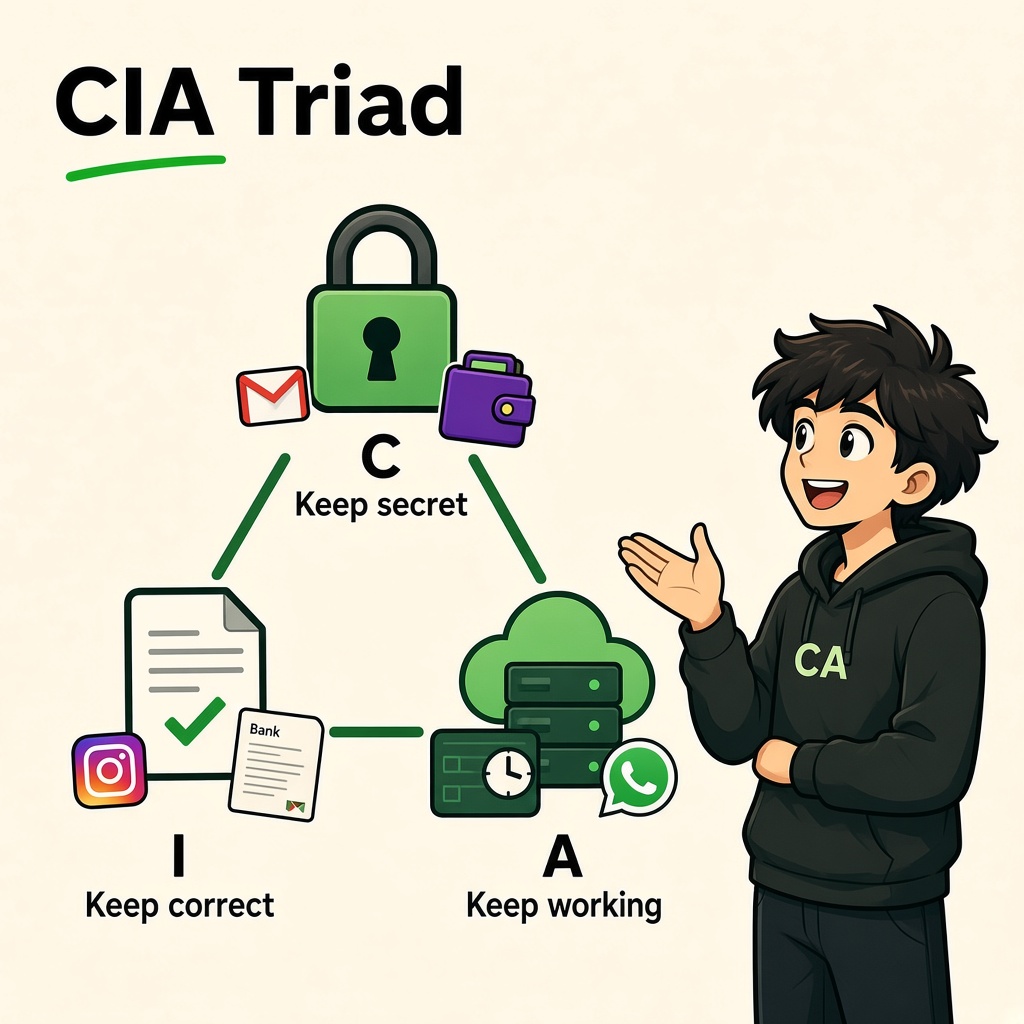
CIA Triad – The Three Goals of Cybersecurity
Module 1 · Introduction to Cybersecurity · Beginner Level
Learn how to keep information private, accurate and accessible through the three fundamental principles of security.
1. Let's Understand the CIA Triad
Imagine you are using your college student portal.
You log in and see your examination results.
Three things must happen for that portal to be secure:
- Other students should not be able to see your private marks.
- Nobody should be able to change your marks without authorization.
- You should be able to access your results whenever the college releases them.
These three requirements represent the three fundamental goals of cybersecurity.
They are called the CIA Triad.
CIA stands for:
- C – Confidentiality
- I – Integrity
- A – Availability
Together, these principles help organizations protect their information and systems.
Let's understand each one with simple examples.
2. Confidentiality – Keep Information Private
Confidentiality means ensuring that information is accessible only to people who have permission to view it.
In simple words:
The right information should be visible only to the right people.
Real-life example
Imagine you have a Gmail account.
Your Gmail contains:
- Personal conversations.
- Bank-related emails.
- Password reset links.
- Important documents.
You don't want strangers reading your private emails.
To protect your account, you:
- Create a strong password.
- Enable Multi-Factor Authentication (MFA).
- Avoid sharing login credentials.
- Check suspicious login notifications.
- Log out from devices you no longer use.
These security measures help maintain confidentiality.
What happens when confidentiality fails?
Imagine someone steals your Gmail password and accesses your account without permission.
They can potentially:
- Read your private emails.
- View personal documents.
- Access sensitive information.
- Attempt to reset passwords for other accounts.
This is a Confidentiality breach.
Other everyday examples
- Only authorized employees can view company salary records.
- Your UPI PIN should remain private.
- Private Instagram messages should not be accessible to strangers.
- Hospital patient records should only be accessible to authorized personnel.
Remember: Confidentiality = Privacy.
3. Integrity – Keep Information Accurate
Integrity means ensuring that information remains accurate, complete and trustworthy, and that changes happen only through authorized processes.
In simple words:
Nobody should be able to change your information without permission.
Real-life example
Imagine your college examination portal displays your marks:
<escape>Mathematics: 85/100</escape>
<escape>Physics: 78/100</escape>
<escape>Computer Science: 92/100</escape>
These marks should remain accurate.
Now imagine someone accesses the system without authorization and changes your Mathematics marks from 85 to 25.
The information is no longer correct.
This is an Integrity violation.
How do organizations protect integrity?
Organizations use:
- Access permissions to restrict who can modify information.
- Audit logs to record important changes.
- Hashing to detect unexpected changes in data.
- Digital signatures to help verify authenticity and integrity.
- Database controls to maintain accurate records.
Other everyday examples
- Your bank balance should not change because of an unauthorized modification.
- A company invoice should display the correct payment amount.
- College attendance records should not be secretly modified.
- Customer orders should contain the correct product and price.
Remember: Integrity = Accuracy and Trust.
4. Availability – Keep Systems Working
Availability means ensuring that authorized users can access information, applications and services whenever they need them.
In simple words:
Your systems and information should be available when required.
Real-life example
Imagine your college announces:
"Examination results will be available at 10 AM."
Thousands of students open the college website at the same time.
But the website becomes unavailable because the server cannot handle the traffic.
Students cannot check their results.
This is an Availability problem.
How do organizations maintain availability?
Organizations use:
- Regular backups.
- Reliable servers.
- Multiple network connections.
- Disaster recovery plans.
- System monitoring.
- Redundant infrastructure.
- DDoS protection.
These measures help systems remain operational and recover when problems occur.
Other everyday examples
- Google Pay should be available when you need to make a payment.
- Hospital systems should remain accessible to medical staff.
- Company email should work during business hours.
- Students should be able to access online learning materials.
Remember: Availability = Accessibility and Reliability.
5. Understand All Three Through One Example
Let's take a simple example: Your Google Drive account.
Imagine you store important college assignments in Google Drive.
| Principle | What should happen? | What could go wrong? |
|---|---|---|
| Confidentiality | Only authorized people access your files | A stranger accesses your private documents |
| Integrity | Your assignments remain unchanged unless you authorize edits | Someone modifies or deletes your work |
| Availability | You can access your assignments when needed | A service outage prevents access |
Notice something important:
Even if your files are private, security is incomplete if someone can secretly modify them or if you cannot access them when needed.
All three principles are important for effective security.
6. How Do the CIA Principles Work Together?
Let's imagine you are running an online shopping website.
Customers use your website to purchase products.
Your website must satisfy all three security goals.
Confidentiality
Customer details, passwords and sensitive payment information must be protected from unauthorized access.
Integrity
Product prices, customer orders and payment records must remain accurate.
Availability
Customers should be able to access the website and complete their purchases when needed.
If even one of these areas fails, the business may face serious problems.
For example:
- Confidentiality failure: Customer information gets exposed.
- Integrity failure: An attacker changes product prices.
- Availability failure: Customers cannot access the website.
This is why cybersecurity professionals consider all three principles while designing security systems.
7. Can Security Principles Conflict With Each Other?
Yes. Sometimes improving one security goal can affect another.
This is called a security trade-off.
Let's understand through two examples.
Example 1: Extra Login Verification
Imagine a banking application asks for additional verification before every small action.
This can improve account protection, but it may also make the application slower or inconvenient to use.
The organization must balance strong security with a smooth user experience.
Example 2: Public Information
Imagine your college publishes an examination timetable on its website.
Students should be able to access it without logging in.
This information is intentionally public.
Here, confidentiality is not the primary requirement. Availability and integrity are more important.
Important: Good security does not mean making everything private or restricting everything. It means applying the right protection according to the purpose and sensitivity of the information.
8. CIA Triad in Applications You Already Use
| Application | Confidentiality | Integrity | Availability |
|---|---|---|---|
| Gmail | Protect private emails | Prevent unauthorized changes to important settings and messages | Access emails when needed |
| Google Pay | Protect credentials | Correct payment amount and recipient | Payments work when needed |
| Protect private messages | Prevent unauthorized changes to posts | Access your account | |
| College Portal | Protect student records | Maintain accurate marks and attendance | Access results and records |
| Razorpay | Protect merchant credentials | Maintain accurate payment records | Keep payment services operational |
9. Common Security Controls
Now let's connect the CIA Triad with actual security technologies.
| Security Control | Main Purpose |
|---|---|
| Strong Passwords | Help protect Confidentiality |
| Multi-Factor Authentication | Help protect Confidentiality |
| Encryption | Protect information confidentiality |
| Hashing | Help detect changes to data |
| Digital Signatures | Help verify authenticity and integrity |
| Access Control | Protect confidentiality and integrity |
| Backups | Help restore Availability and Integrity |
| Firewalls | Help protect systems and network resources |
| Monitoring | Help identify suspicious activities and service problems |
Note: Some security controls support more than one CIA principle. Their effectiveness depends on how they are implemented.
10. Easy Memory Trick – CIA Coffee
Imagine you ordered a cup of coffee.
Remember these three things:
C – Confidentiality
Your coffee is kept private. Nobody else should access what belongs to you.
I – Integrity
Nobody should secretly change your coffee ingredients or replace your order.
A – Availability
Your coffee should be ready when you order it.
One more simple memory trick:
- Confidentiality = Who can see it?
- Integrity = Can someone change it?
- Availability = Can I access it?
Lesson Summary
You have learned the three fundamental goals of cybersecurity:
Confidentiality: Protect information from unauthorized access.
Integrity: Keep information accurate and prevent unauthorized modifications.
Availability: Ensure systems and information are accessible when needed.
You also learned:
- How the CIA Triad works in everyday applications.
- Why all three principles are important.
- How security controls support each principle.
- Why organizations must balance security and usability.
- How to identify CIA violations in real-world situations.
Before moving forward, make sure you can explain Confidentiality, Integrity and Availability in your own words without looking at the notes.
Coming Next: Authentication, Authorization & Accounting (AAA)
You now understand what security needs to protect. Next, you will learn how systems identify users, decide what they are allowed to do, and record their activities.
CYNARKS Academy – Learn to Understand. Practice to Defend.
Practice security testing only on systems you own or have explicit authorization to test.
End of lesson
Quiz · Tasks · Labs
Pass the quiz (≥70%), check off tasks, then mark the lesson complete to earn Foundations badges.
Knowledge check
Answer all, then submit1. Someone accesses your private Gmail account without permission and reads your emails. Which CIA principle is affected?
2. An unauthorized person changes a student's examination marks from 85 to 25. Which principle is violated?
3. A hospital's computer systems become unavailable, and doctors cannot access patient records. Which principle is affected most directly?
4. Which security measure helps detect unexpected changes to a file?
5. A college publishes its examination timetable publicly so every student can access it. Which principle is especially important here?
6. Which of the following represents all three CIA principles?
Lesson tasks
Practice labs
In-browser labs for this lesson — free with Fundamentals enrol.
- CIA Triad MatchFundamentals
Finish the quiz and tasks to unlock Mark as completed.