Lesson 2 of 31 · ~22 min
Information Security vs Cybersecurity
Overlaps and differences in practice.
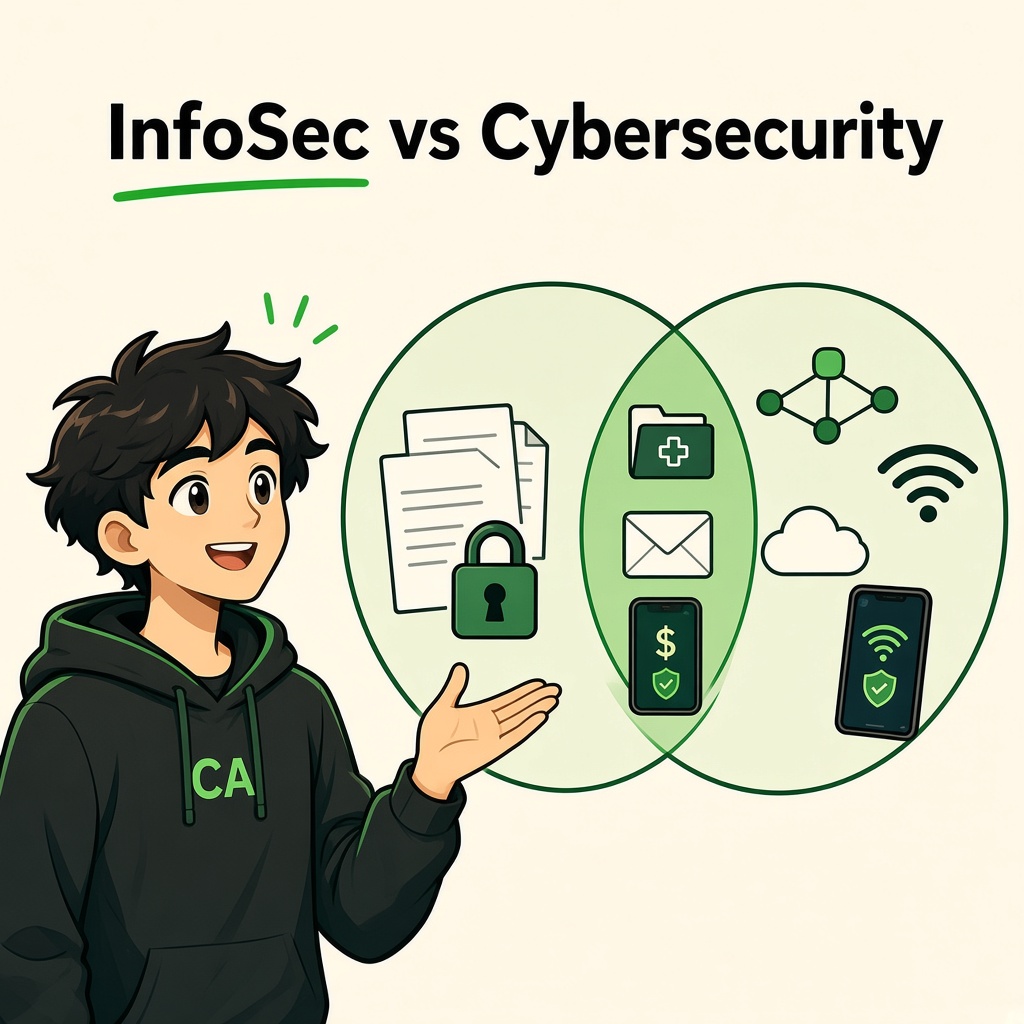
Information Security vs Cybersecurity
Module 1 · Introduction to Cybersecurity · Beginner Level
Understand how information is protected, whether it exists on paper, inside a computer, or across the internet.
1. Let's Understand the Difference
Imagine your college has important student information:
- Student names and phone numbers.
- Examination marks.
- Attendance records.
- Fee payment details.
- Student certificates.
Now imagine the college stores this information in two places:
- Printed documents inside a physical filing cabinet.
- Digital records inside a computer and college database.
Both contain important information. Both need protection.
But here is the interesting part:
Protecting printed documents and protecting digital systems involve different types of security.
This brings us to two important concepts:
Information Security (InfoSec) and Cybersecurity.
2. What Is Information Security?
Information Security means protecting information from unauthorized access, use, modification, disclosure, destruction or loss.
The information can exist in any form:
- Paper documents.
- Printed examination records.
- Digital files.
- Emails and messages.
- Company databases.
- Confidential business information.
Simple meaning: Information Security protects important information, regardless of where or how it is stored.
Real-life example
Imagine a hospital stores patient information.
The hospital has:
- Printed patient reports.
- Medical records in filing cabinets.
- Digital patient records.
- Patient information stored in its database.
To protect this information, the hospital:
- Keeps physical documents in locked cabinets.
- Allows only authorized employees to access patient records.
- Uses passwords to protect digital accounts.
- Maintains backups of important records.
- Trains employees to handle confidential information safely.
All these activities are part of Information Security.
Remember: Information Security is about protecting the information itself.
3. What Is Cybersecurity?
Cybersecurity focuses on protecting digital devices, systems, applications, networks and information from cyber threats.
It protects things such as:
- Computers and mobile phones.
- Websites and applications.
- Networks and Wi-Fi.
- Cloud platforms.
- Digital databases.
- Online accounts and services.
Simple meaning: Cybersecurity protects your digital world from cyber attacks and unauthorized access.
Real-life example
Imagine you use Gmail on your mobile phone.
Someone tries to access your Gmail account without your permission.
Cybersecurity measures help protect your account through:
- Strong passwords.
- Multi-Factor Authentication (MFA).
- Suspicious login detection.
- Security alerts.
- Account recovery mechanisms.
These measures help prevent unauthorized access to your digital account.
Remember: Cybersecurity focuses on protecting systems and information in the digital environment.
4. Understand the Difference Through One Simple Example
Imagine you have your college examination marksheet.
You have two copies:
<escape>Copy 1: Physical Marksheet</escape>
You keep your printed marksheet inside a locked cupboard so nobody can steal or damage it.
This is Information Security.
<escape>Copy 2: Digital Marksheet</escape>
You upload a PDF copy to Google Drive and protect your account using a strong password and MFA.
This involves both Information Security and Cybersecurity.
Why both?
- Information Security protects the confidentiality and integrity of your marksheet.
- Cybersecurity protects the digital account, device and online storage used to access it.
This is the easiest way to understand their relationship.
5. Information Security vs Cybersecurity – Quick Comparison
| Information Security | Cybersecurity |
|---|---|
| Protects information in any form | Focuses on digital systems and environments |
| Includes paper and digital records | Includes computers, networks and applications |
| Protects confidentiality and integrity of information | Protects digital assets against cyber threats |
| Includes physical security and policies | Includes firewalls, endpoint security and digital controls |
| Covers people, processes and technology | Focuses on technology and digital security |
Examples in Everyday Life
| Situation | Information Security | Cybersecurity |
|---|---|---|
| Keeping printed bank statements in a locked cupboard | Yes | No |
| Protecting Gmail with MFA | Yes | Yes |
| Installing a firewall on a company network | Supports InfoSec | Yes |
| Shredding confidential documents | Yes | No |
| Encrypting company files stored online | Yes | Yes |
| Restricting access to a digital database | Yes | Yes |
Important: These are practical examples, not completely separate categories. Many security activities belong to both areas.
6. How Are They Connected?
Think of Information Security as the bigger picture.
It protects information wherever it exists.
Cybersecurity focuses on the digital environment, where information is stored, processed and transmitted.
<escape>Information Security → Broader protection of information</escape>
<escape>Cybersecurity → Protection of digital systems and environments</escape>
For example, protecting a company's customer database requires both:
- Information Security: Deciding who is allowed to access customer information and how it must be handled.
- Cybersecurity: Securing the database, servers, applications, accounts and networks against digital threats.
One important point: Cybersecurity is commonly treated as a specialized area within the broader Information Security discipline, although organizations sometimes use these terms differently.
7. Three Real-World Situations
Scenario A: A College
A college has student records.
It:
- Locks physical student files inside cabinets.
- Restricts access to confidential documents.
- Protects its online student portal.
- Uses secure logins for examination records.
Which security areas are involved?
Answer: Both Information Security and Cybersecurity.
Scenario B: A Company
An employee writes their password on a sticky note and leaves it on their desk.
Someone else sees it.
This is an Information Security problem because confidential access information was not handled safely.
It can also create a Cybersecurity risk if someone uses that password to access a company account.
Scenario C: An Online Business
A company stores customer information in a cloud database.
An attacker exploits a security weakness and accesses customer records.
This is a cybersecurity incident and also an Information Security incident because confidential information has been exposed.
Lesson: One security incident can affect multiple areas of security.
8. Who Works in These Areas?
Both fields offer different career opportunities.
| Information Security Roles | Cybersecurity Roles |
|---|---|
| Information Security Analyst | Security Analyst |
| Information Security Manager | SOC Analyst |
| GRC Analyst | Penetration Tester |
| Risk and Compliance Analyst | Security Engineer |
| Security Auditor | Incident Responder |
There is considerable overlap between these careers.
For example, a Security Analyst may work on both information protection policies and technical security controls.
9. Important Terms to Remember
Before moving forward, understand these four basic terms:
1. Information
Any valuable data, such as documents, marks, emails or customer records.
2. Information Security
Protecting information regardless of its format or storage location.
3. Cybersecurity
Protecting digital systems, networks, applications and information from cyber threats.
4. Security Controls
Measures used to protect information and systems.
Examples include passwords, MFA, firewalls, encryption, access permissions and physical locks.
Lesson Summary
You have now learned:
- What Information Security means.
- What Cybersecurity means.
- How the two concepts are different.
- Why both are important.
- How they overlap in real-world situations.
- Examples from colleges, hospitals and businesses.
- Basic security terminology.
The most important takeaway:
Information Security protects information in every form. Cybersecurity focuses on protecting the digital world where that information lives and moves.
Coming Next: The CIA Triad
You have already seen the three important principles of cybersecurity: Confidentiality, Integrity and Availability.
In the next lesson, you will understand each principle in greater detail through real-world examples and practical scenarios.
CYNARKS Academy – Learn to Understand. Practice to Defend.
End of lesson
Quiz · Tasks · Labs
Pass the quiz (≥70%), check off tasks, then mark the lesson complete to earn Foundations badges.
Knowledge check
Answer all, then submit1. What does Information Security protect?
2. What is the main focus of Cybersecurity?
3. You keep your printed bank statements inside a locked cupboard. Which area does this mainly belong to?
4. You enable MFA on your Gmail account. Which areas are involved?
5. A company database is hacked and customer information is exposed. What is affected?
Lesson tasks
Practice labs
In-browser labs for this lesson — free with Fundamentals enrol.
- Zero Trust PhraseFundamentals
- AuthN vs AuthZFundamentals
Finish the quiz and tasks to unlock Mark as completed.